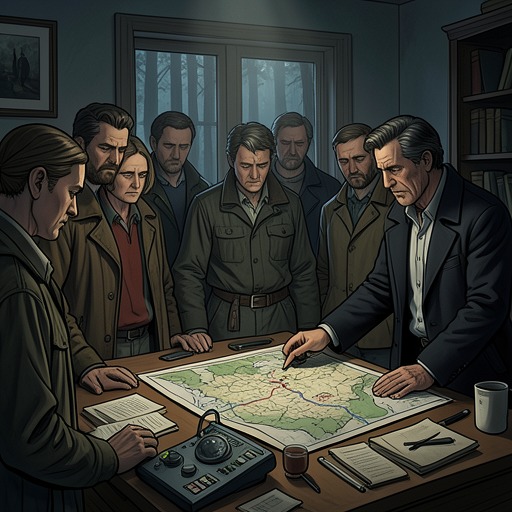
The collapse of the Kettle Springs Improvement Society conspiracy
Clown in a CornfieldThe collapse of the Kettle Springs Improvement Society conspiracy reveals the violence beneath its promise of civic renewal: George Dunne and Arthur Hill framed Kettle Springs’ troubles as a generational crisis and organized a campaign to eliminate young people in the name of saving the town. Their plan briefly drew support by exploiting economic anxiety and collective grief, but the party massacre did not produce the restoration they imagined. Instead, survivors stayed, investigators traced the conspiracy, and the technologies its leaders despised helped expose them.
Crisis and Civic Appeal
The conspiracy took shape against a town’s overlapping losses. Kettle Springs was losing population, Baypen factory had burned, and residents were waiting for Arthur Hill to reopen the refinery and invest in the community. At a tense meeting about Founder’s Day, Harlan Jaffers tried to quiet complaints by praising the event’s floats and costumes, which had been made on a quarter of the usual budget. When townspeople raised the damaged fire-engine pump and the town’s finances, he offered a more consequential possibility: Arthur might attend the parade and reinvest if he liked what he saw. The prospect changed the room’s mood, even though Arthur had scarcely been seen in town for nearly a year. George Dunne redirected that hope into a grievance. He invoked Arthur’s recent bereavement and the factory fire, then blamed Kettle Springs’ declining population and young people’s supposed indifference to local history. He argued that legal authority might not be enough to preserve the town and urged the assembled community to take action. The claims made economic distress and personal grief part of one story: the town was in danger, and the younger generation was to blame. The rhetoric also drew force from an earlier tragedy. After Victoria Hill died at the reservoir, local residents blamed Harlan Jaffers for mishandling the situation with Arthur Hill’s daughter. Dunne could thus present the Hill family’s grief as both private loss and evidence of a broader communal failure. At the meeting, he insisted that adults themselves bore responsibility for the town’s condition, then called for action rather than continued self-pity. His appeal offered a sense of purpose while shifting attention from the conspirators’ choices to a purported threat posed by young people.
Recruitment and Escalation
The Kettle Springs Improvement Society conspiracy grew through gradual, selective recruitment rather than a single public announcement. In George Dunne’s later account, the organizers spent months bringing together people they believed would listen and had a role to play. They withheld parts of the plan from members, reasoning that disclosure all at once would frighten them away. This uneven flow of information let participants join a campaign for community improvement without necessarily knowing its eventual purpose. Dunne described the Society’s method as incremental persuasion: organizers listened to grievances, affirmed what people wanted to hear, and moved the boundaries of acceptable action without making the destination explicit. The process transformed suspicion of social change into support for a radical solution. At the public meeting, Dunne asked everyone willing, able-bodied, and of age to be deputized, and demanded that those unwilling to join leave. The crowd responded with murmurs of enthusiasm and amazement; Harlan objected that the town was being treated like the Wild West. The demand made the movement’s coercive edge visible: participation was framed as a civic duty, while dissenters were pushed out. Dunne also pointed to an earlier effort to keep selected students away from the event, an effort that had plainly failed. The later plan depended not on preventing the young people from gathering, but on knowing where and when they would be together. The Founder’s Day stunt heightened the town’s sense of urgency and helped persuade residents that immediate action was necessary. Dunne said that the party was convenient because the organizers knew the place, the time, and that Cole Hill’s social circle would be there. His account makes the gathering’s apparent spontaneity part of the conspiracy’s practical design.
The Blighted-Crop Doctrine
Dunne’s justification rested on treating an entire generation as a threat to the community. He told Cole Hill that young people were bad, whether supposedly made so by their upbringing or by phones, the internet, music, and social media. He then compared them to a blighted crop: in his explanation, pests or fungus spread unless a farmer cuts and culls the affected plants, burns the harvest if necessary, and lets the field lie fallow. The agricultural metaphor converted people into contamination and mass killing into a supposed act of land management. Cole challenged the logic directly. He understood Dunne’s reasoning as a plan to wipe out a generation because older residents believed young people did not respect them, while refusing to listen to the young in return. Dunne treated Cole’s anger as confirmation of his diagnosis, turning dissent into further proof that the target group was irredeemable. His explanation of the conspiracy therefore depended on a closed argument: young people were dangerous, and any protest against that label could be used to reinforce it. The violence was also presented as a means of rescuing the town. Dunne insisted that the party had been an opportunity rather than the plan’s original objective, resisting Cole’s description of the killings as a deliberate attack on high-school students. Yet he acknowledged that the organizers knew who would attend and chose the gathering because it concentrated their intended targets. The gap between the language of community preservation and the planned killing of young people is central to the conspiracy’s moral logic—and to its exposure as a political project, not an act of rescue.
Exposure and Collapse
The conspiracy’s secrecy proved incomplete. Dunne acknowledged that Dr. Weller, once among the Society’s vocal supporters, threatened to expose the group. The organizers considered this a problem they had to settle together. His account reveals both the danger of internal dissent and the lengths to which the group went to contain it; secrecy was not simply a matter of keeping outsiders uninformed, but of controlling what members themselves could know and say. After the attack, records connected the organizers to the Society. The Federal Bureau of Investigation’s arrival was followed by questioning and arrests. Arthur Hill’s phone records, emails from the sheriff’s office, and location data from phones that had registered at Kettle Springs Improvement Society meetings helped investigators identify accomplices. The conspirators had distrusted modern technology, but many had not covered their digital traces. Their private meetings and communications left a trail that the authorities could follow, and few living accomplices remained to escape the resulting scrutiny. This reversal gives the conspiracy’s anti-technology posture an especially sharp irony. Dunne had listed phones, the internet, music, and social media among the forces supposedly corrupting young people. Yet digital records helped reveal who had met, where the group had gathered, and how its members were connected. Quinn Maybrook recognized that the phones the conspirators hated were among the tools that helped bring them down. Their belief that young people’s technology was a source of moral decay could not protect them from its evidentiary record.
Aftermath and Failed Restoration
In the immediate aftermath, Quinn Maybrook persuaded Glenn Maybrook not to leave Kettle Springs. She believed that the town had become their home and that retreat would concede victory to the killers. Her decision stands against the conspiracy’s claim to speak for the whole community: the survivors’ choice to remain offered a different account of belonging, one not based on excluding or destroying a generation. The return of students made that survival concrete. When school resumed in early December, around twenty returning students had been at Tillerson B-field during the attack. Most had survived being locked in the barn and escaped into the corn before the clown reinforcements arrived. Another fifteen or so students had not attended the party. The young people Dunne had described as a crop to be culled had not vanished; those who lived continued into the next school term. The conspirators did, in one sense, bring renewed activity to Kettle Springs, but not on their terms. The massacre drew television crews, law-enforcement personnel, and true-crime documentarians; people arriving to cover or investigate the case needed places to stay and eat, giving the town a sustained economic boost over the following months. Some residents resented the attention, while many welcomed the outsiders. The influx resembled the revival Arthur Hill and George Dunne had claimed to seek, but it arose from public scrutiny and the aftermath of violence, not from the Society’s intended restoration. The plan’s central promise consequently failed. The conspirators had treated young people as the cause of Kettle Springs’ decline and their removal as the route to recovery. Quinn’s insistence on staying, the returning students, and the arrests all contradict that premise. The town’s survival did not depend on the destruction of its youth; the attempt to impose that destruction instead exposed the conspiracy and left its organizers answerable for what they had done.